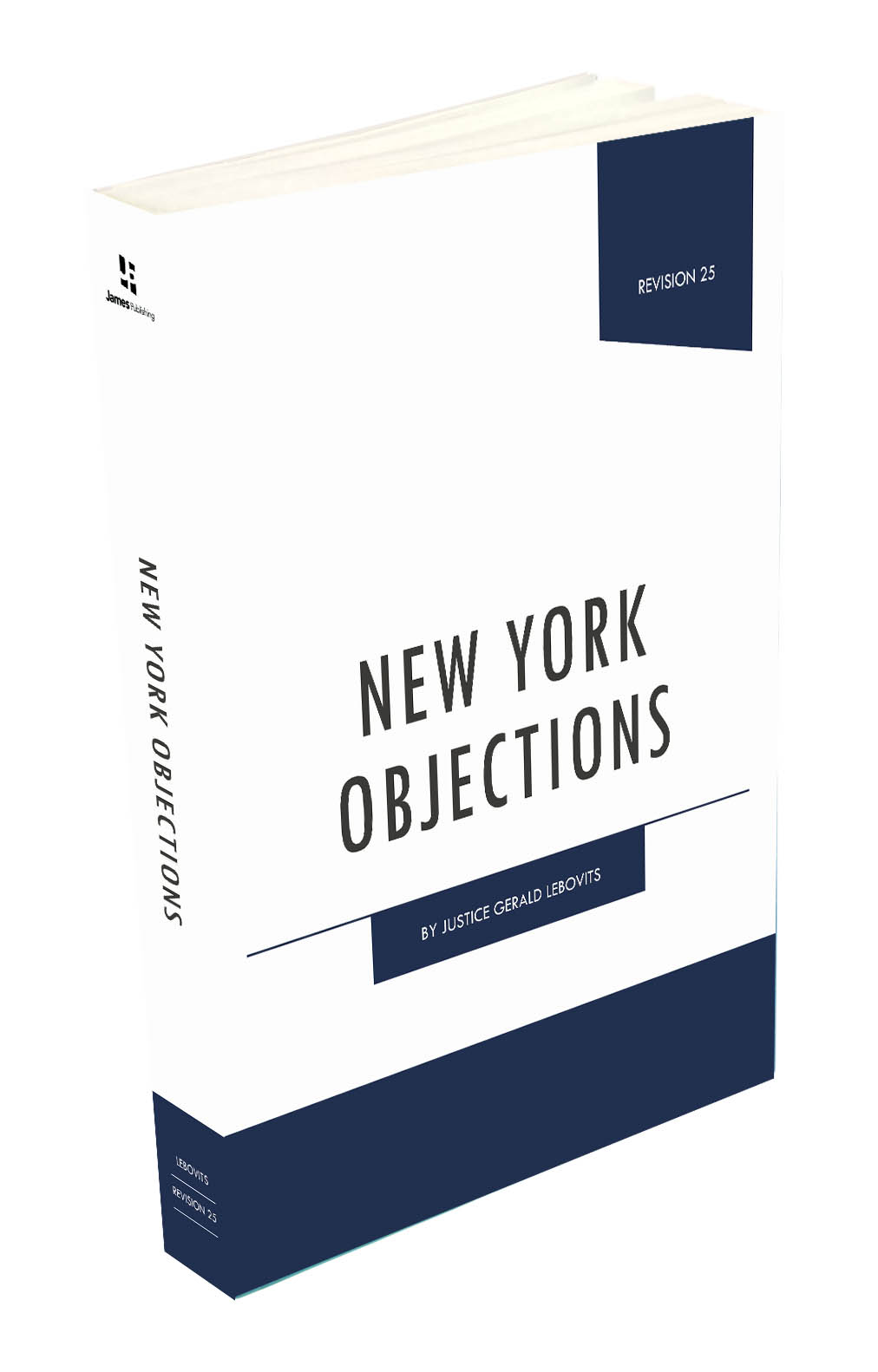
New York Objections
$32.86
$58.49
Description In 1998, the first edition of New York Objections was hailed as a “detailed and comprehensive guide to the entire trial process … filled with in-depth practical advice, [that] will serve as a great resource for the litigator.” Joel Slawotsky, New York Law Journal. That endorsement holds true, to an even greater degree now, more than two decades later. Specially Designed for Courtroom Use Winning at trial means getting your evidence in and keeping the opposition’s evidence out — or at least minimizing its impact. Most evidentiary rulings are within the judge’s discretion, and are made in seconds. Bad rulings are almost never reversible. In sum, victory goes to the lawyer who can prevail on the big objections in the heat of battle. The key is knowing why, when and how to object and how to respond — at a moment’s notice — with supporting authority at your fingertips. That’s where New York Objections comes in. Like no other resource, New York Objections uses a courtroom-friendly format to cover more than 100 trial objections with clear, concise explanations, practice tips, and cautions — plus the rules, statutes, and cases that comprise and construe New York’s rules of evidence. Pattern Objections Model language for more than 100 objections. Use the language provided — or tailor it to fit your specific situation. You can turn to the model language you need in seconds. Comments Author comments are included for each objection. The authors explain the practical application, scope, and purpose of the governing rules, and describe the circumstances in which each objection is proper and most effective. Practice Tips & Cautions The text includes an abundance of practice tips and cautions, alerting you to common mistakes and important strategies. Cases The facts and holdings of 1500 cases (about 15 per objection) are summarized so you can quickly find supporting authority. Response Opposing counsel objects — and thanks to New York Objections, you have the ammunition to respond. Better yet, you know how to anticipate and preclude objections before they are made. You also know what reactions to expect from the judge, how to meet alternative admission procedures, and more. Foundation New York Objections tells you how to meet the foundation requirements for specific types of evidence. You’ll find instructions on how to lay your foundation and spot weaknesses in your opponent’s. Tactics Anticipate evidence problems and plan your strategies. The authors’ advice and insights from the bench give you the best chance of success. They include alternative arguments, judicial perspectives and preferences, and what you need to put on the record. New York attorneys must marshal far-flung rules, statutory provisions, and ever-developing common law. Other evidence books are full-blown academic treatises — not well-suited for handling courtroom exigencies. New York Objections bridges the gap. Organized by topic, it explains New York’s evidence rules, citing all the state’s relevant rules, statutes, and more than 1,500 New York cases directly on point. Don’t let opposing counsel’s objection block the admission of critical evidence, and don’t be caught off guard when opposing counsel offers evidence you could have kept out, had you just made the proper objection. Whether you’re in the courtroom or preparing for trial, New York Objections will help you use the rules of evidence to your best advantage. Written by respected New York trial judges, this book has the most comprehensive coverage of New York objections ever published. New York Objections is what you need to: Preclude trial objections through motions in limine. Evaluate the admissibility of the opposition’s evidence. Decide when to object, and when to remain silent. Preserve the record for appeal. Respond to objections — on the spot, and with authority. Draft briefs on evidentiary objections and motions. Prevent jury exposure to adverse inadmissible evidence. In sum, “There are numerous treatises, books and articles on evidence and trial tactics, which include coverage of making and responding to objections. However, few publications combine these subjects in as clear and useful a way as New York Objections.” —David M. Epstein, New York Law Journal REVISION 25 HIGHLIGHTS This 25th Edition of New York Objections updates the governing law with new text and more than 150 new case summaries throughout the book. The highlights include expanded coverage of objections related to: Jury Selection: Challenges for cause Discriminatory use of peremptory challenges “Color” as a cognizable group distinct from “race” Opening Statement: Failure to make an opening statement Failure to set forth a claim Hearsay: Admission by conduct Medical records Police records, 911 calls. Confusing, Prejudicial, Cumulative: Bolstering Missing witness charge Real Evidence: Chain of custody Exhibition of person to show injury or condition Photographs, Recordings, X-Rays: Police bodycam footage Surveillance tapes Telephone recordings Documents : Impeachment distinguished Dead Man’s statute NEW! Appendix: Evidentiary Issues in Matrimonial and Family Court Cases, by attorney Joel R. Brandes Submission to Jury: Untimely/inadequate objection to instructions; court’s response to juror questions and read-back requests. AND MORE! ABBREVIATED TABLE OF CONTENTS CH. 1 OBJECTIONS & RELATED PROCEDURES CH. 2 JURY SELECTION CH. 3 OPENING STATEMENT CH. 4 RELEVANCE & MATERIALITY CH. 5 HEARSAY CH. 6 CONFUSING, PREJUDICIAL, & CUMULATIVE CH. 7 PRIVILEGES CH. 8 CHARACTER & HABIT CH. 9 REAL EVIDENCE CH. 10 PHOTOGRAPHS, RECORDINGS, & X-RAYS CH. 11 DOCUMENTS CH. 12 PAROL EVIDENCE CH. 13 DEMONSTRATIVE EVIDENCE CH. 14 WITNESS COMPETENCE CH. 15 WITNESS EXAMINATION CH. 16 EXPERT WITNESSES CH. 17 JUDICIAL CONDUCT CH. 18 ATTORNEY CONDUCT CH. 19 SUMMATION CH. 20 SUBMISSION TO JURY CH. 21 OBJECTING DURING DEPOSITIONS ABOUT THE AUTHOR Justice Gerald Lebovits has been a New York City judge since 2001. A Supreme Court justice in Manhattan, he served as president of the New York State Association of Acting Supreme Court Justices, the Board of Judges of the New York City Civil Court, and the New York City Association of Housing Court Judges. He also served as a Manhattan Criminal Court judge. Justice Lebovits has been an adjunct professor of law for 37 years, currently at Columbia, Fordham, and NYU. The students at Fordham, New York Law School, and St. John’s have each elected him Adjunct Law Professor of the Year. The author of eight books and more than 350 articles, Justice Lebovits has given hundreds of lectures on evidence, legal writing, ethics, criminal practice, civil practice, and landlord-tenant law for judges, bar associations, and government agencies across the United States and in Canada, Kenya, Mexico, and Qatar. Justice Lebovits has a B.A. in law (Carleton Univ. 1976), two certificates in law (Dalhousie and Sherbrooke law schools 1978), and a license in law (LL.L.) (Univ. of Ottawa 1979), all from Canada (where he is from). He also has two graduate U.S. law degrees, from Tulane (M.C.L. 1980) and NYU (LL.M. 1986).
Customer Picks